Friday, 19 March 2010

The Queer Bible: Beyond Family Values

Under the heading,  "A Way Back Behind Christian Homophobia", Adam Kotsko writes at the blog "An und fur sich" about a trilogy of books by Ted Jennings: Jacob’s Wound: Homoerotic Narrative in the Literature of Ancient Israel, The Man Jesus Loved: Homoerotic Narratives in the New Testament, and the third in the set, Plato or Paul?: The Origins of Western Homophobia:
"The strategy here is clear, aggressive, and absolutely necessary: he absolutely abandons the defensive stance -of “explaining away” the supposedly “obvious” homophobic elements in the Bible that “everyone knows” about and instead presents us with a scriptural account that is deeply homophilic, even to the point of presenting us with a possible male lover for Christ himself."
Setting aside the weapons of hate

Even discounting the possibility that Jesus had a male lover (there are at least two candidates:  John, the "apostle Jesus loved", and Lazarus), this is an approach I love.  Given the way in which queers have for centuries experienced Scripture as a weapon of hate, it is understandable that after one has overcome a natural antipathy to dealing with Scripture at all, the first enquiry from lesbigay people is to  find ways to respond to the infamous clobber texts, to learn to set aside the weapons of hate.  This is technically relatively easy - the actual texts are few, out of 30 000 verse in a Bible written against a cultural background where homoeroticism was commonplace, and many scholars have shown how they have either been misinterpreted, or are of limited relevance to modern gay relationships.

More difficult is dealing with the residual emotional baggage: this is where books pointing to positive interpretations of Scripture are so valuable. Again, this should be easy - the fundamental message of the Gospels has nothing to do with hatred against anybody, but stresses love and inclusion for everybody - most especially social outsiders and the otherwise afflicted and oppressed.  Still, for people with a homophile orientation, we can go well beyond the simple message of generic inclusion. Writers on Scripture have pointed to specifically queer values in Scripture, while historians have shown that the roots of popular hostility did not lie in Scripture at all:  the Church followed popular prejudice, not the other way around.

I do not yet have personal knowledge of Jennings' books (but will explore further). There are other writers though who have covered much the same ground, with whose work I am more familiar.

Setting aside family values

Chris Glaser, in his excellent book, "Coming Out as Sacrament", has a chapter on "Coming out in the Bible", in which he reads several well known Scripture stories, from Adam & Eve in Genesis to Pentecost in Acts,  as coming out tales.  Among these, he presents the story of Jesus Himself as "Coming out of Family Values".  The evidence he produces in support of this argument is that:
  • "his mother Mary was told that Jesus' own coming out would mean "that the inner thoughts of many will be revealed - and a sword shall pass through your own soul too (Luke 2:35)";
  • At twelve years of age,  Jesus ignored his family's departure from Jerusalem to sit  in the temple, his "Father's house" (Luke 2:49);
  • He left His family and as far as we know, never married and never "begat" children;
  • He called his disciples away from their families (9:59:62), told them he had no home (9:57) ,, and claimed that His gospelk would "set a man against his father, and a daughter against her mother." (Mathew 10:35-36);
  • When His family came to see  Him, He declared, "Whoever does the will of god is my brother and sister and mother"(Mark 3:35);
  • Members of the new faith community addressed each other as brother and sister;
  • Jesus' own family of choice were three unmarried people - Martha, Mary and Lazarus;
  • In the New Testament, the biological, polygamous, prolifically procreative family of the Old Testament was superseded by the more vital, eternal and extended family of faith, a family to be expanded by evangelism and inclusivity rather than mere procreation;
  • Jesus had a special word of defence for the eunuch, who was an outcast in Israel because his body was mutilated, but more importantly because he could not procreate. "
I don't know about you, but to me, but none of this, neither Old Testament nor New, sounds particularly like the "traditional family values" that the fundies claim to be protecting because they believe them to be at the heart of Christianity.

Urban gay men as role models

Going beyond queer values in the Gospels to queer lives today, the American theologian Kathy Rudy argues that this Scriptural denial of modern "family values" implies that modern urban gay culture is more in tune with the Gospel message than the biological family which Christ's teaching rejected
"The church needs the model of gay sexual sexual communities because Christians have forgaotten how to think about social and sexual life outside the family".
Writing about Rudy's work, Elisabeth Stuart notes that
"The church has forgotten how to be a community, how to be the body of Christ and perhaps gay men have the grave task of teaching it to be a community wider than a family."
Wow!

How far have we come?  Instead of simply sitting back and accepting the knee jerk, unfounded  accusations of "Sodomy", we find that there are serious, credible Scripture scholars and theologians who have first, shown that the traditional use of the clobber texts to atack us is at best inappropriate, or possibly totally unfounded; that there are positive role models in Scripture, in both the Old Testmament and the New;  that far from encouraging traditional family values, the Gospel message opposes themwith what are quite frankly queer values, and that far from the fundies being in a position to lecture us on how to behave, we should be teaching them a thing or two about the Gospels and how to move beyond an unChristian "Focus on the Family" to a wider "Focus on Community"!

Beyond gender.

Rudy continues, says Stuart, to "construct a sexual ethic which is communal in nature and queer in its politics."  Because in recent centuries there has been so much emphasis on first reproduction and then on complementarity as the sole purposes of sex, the result is that "celibacy, singleness and communal life, which have been valued for so long in Christian history, no longer have a place in Christian life."

In a neat inversion of the story of Sodom, "for Rudy the story of Sodom teaches us that what is ultimately pleasing to God about sexuality is the quality of its hospitality.  This is not to say that every stranger must be offered sex, but that sex must cultivate an openness  and warmth to strangers, it must open our hearts, break down our boundaries, and push us beyond ourselves.  Hospitality is procreative, it expands and widens the community.  When we open our homes to outsiders, the private space of the home becomes the public space of the Church, and so not only is gender collapsed but so is the dualism between private and public. The cult of domesticity is destroyed and replaced by an ethic which subverts worldy concepts of gender and understands sex in the context of building up the body of Christ."

How far from James Dobson is that?


See also:
Queering the Church:
Books:
Althaus-Reid, Marcella: Indecent Theology
Horner, James: Johnathan Loved David

Mollenkott, Virginia Ramey:  Omnigender
Rudy, Kathy: Sex and the Church
Stuart, Elisabeth: Gay & Lesbian Theologies

Tuesday, 16 March 2010

The Sin That Cries to Heaven For Vengeance

For a long time, I've been thoroughly irritated by those sanctimonious Catholics (and others) who tray to remind us (for our own good, they would claim) that homosexuality is "the" sin that cries out to heaven for vengeance.  However, as I had never myself come across any such reference, I did not know the origin of the claim, and could not respond.  Finally, I got my act together and investigated. What I found was useful, and worth sharing.

First, as one might expect, there is not such thing as "the" sin that cries out, but several: depending on your source, there are four or five of them.  The claims for grouping these together come from old sources, and are based on a shared interpretation of Biblical verses.  Apart from the allegation that "homosexuality" is one of them, the others are:

Murder (not surprising):
And the Lord said, “What have you done? The voice of your brother’s blood is crying to me from the ground.” (Gn 4:10)
Oppression of Widows and Orphans
“You shall not afflict any widow or orphan. If you do afflict them, and they cry out to me, I will surely hear their cry.” (Ex 21-23)
Now, I would have thought that a failure to provide health care to widows and orphans counts as "oppression".
Cheating Laborers of Their Due

“You shall not oppress a hired servant who is poor and needy, whether he is one of your brethren or one of the sojourners who are in your land within your towns; you shall give him his hire on the day he earns it, before the sun goes down (for he is poor, and sets his heart upon it); lest he cry against you to the Lord, and it be a sin in you.” (Dt 24:14-15)
So, paying unfair low wages is  also a sin crying out to the Lord.

Sodomy
Then the Lord said, “Because the outcry against Sodom and Gomorrah is great and their sin is very grave, I will go down to see whether they have done altogether according to the outcry which has come to me.” (Gn 18:20-21) The inhabitants of Sodom and Gomorrah were guilty of homosexual activity. So far gone were they in this vice that the men of the town would not even accept heterosexual license with Lot’s daughters, both virgins, as a means of sating their lust (see 19:8-9).
Ah, there it is - the old canard that homosexuality is the sin of Sodom. It is not - as any actual reading of the Bible, and not the endless commentary that abuses it, makes clear. I will return to this below.

The four cases listed above are the four given at the  "Catholic Doors" website, which also warns us (ironically to interpret these carefully, free from cultural conditioning.  Yet their interpretation of the Sodom story is entirely based on cultural conditioning.  It is not Scripture, but popular prejudice that has associated the sin of Sodom with homoeroticism. History shows that religious opposition to same sex relationships has followed  popular bigotry, not led it.

Another source , the blogger Douglas Lawrence, adds to the above list a fifth, the "oppression" in Egypt:.
Q. 1. How many sins cry out to Heaven for vengeance?


A. There are five sins that cry out to Heaven for vengeance.

Q. 2. What are they?

A. Based on # 1867 of the Catechism of the Catholic Church, there are:

(1) Wilful murder - the blood of Abel, [Gen. 4:10]

(2) The sin of the Sodomites, [Gen. 18:20; 19:13]

(3) The cry of the people oppressed in Egypt, [Ex. 3:7-10]

(4) The cry of the foreigner, the widow and the orphan, [Ex. 20:20-22] and

(5) Injustice to the wage earner. [Deut. 24:14-5; Jas. 5:4]


So, what is this "sin of Sodom"?  Canon Bailey, writing half a century and more ago, did extensive research in Scripture, in the Apocrypha, and in the Pseudepigrapha, and came up with some clear answers.
Genesis 19, which tells the story of Sodom's destruction, is remarkable vague on the subject of the precise sin that had brought down this dramatic penalty. I had read previously (in Boswell, and elsewhere) some of the texts from other books of the Hebrew scriptures that tell us more, but Bailey has an impressively long list. Gay men in particular,who have for so long been beaten over their heads for their supposed "sin of Sodom", would do well to absorb these, and understand just what the true sin is.
Jer 23:14
In the prophets of Jerusalem also I have seen a horrible thing; they commit adultery, and walk in lies, and they strengthen the hands of evil-doers, that none doth return from his wickedness: they are all of them become unto me as Sodom , and the inhabitants thereof as Gomorrah.
Ez 16: 49-50
Behold, this was the iniquity of thy sister Sodom; pride, fulness of bread, and prosperous ease.....; And they were haughty, and committed abomination (to ‘ēbhāh) before me: therefore I took them away as I saw good.
Wisd 19: 8
Whereas the men of Sodom received not the strangers when they came among them; the Egyptians made slaves of the guests who were their benefactors.
Ecclus 16: 8
God spared not those with whom Lot sojourned, whom he abhorred for their pride
3 Maccabees 2:5
"Thou didst burn up with fire and brimstone the men of Sodom, workers of arrogance, who had become known for all their crimes
Jubilees 13: 17
The Men of Sodom were sinners exceedingly
Jubilees 16: 5-6
The Lord executed his judgement on Sodom, and Gomorrah, and Zeboim, and all the regions of the Jordan ad he burned them with fire and brimstone, and destroyed them until this day, even as I have declared unto thee all their works, that they are wicked and sinners exceedingly, and that they defile themselves and commit fornication in their flesh...
Jubilees 13: 17
And Abraham told of the judgement of the giants and the judgement of the Sodomites, how they had been judged on account of their wickedness, and had died on account of their fornication,  and uncleanness.....
Josephus, Antiquities
About this time, the men of Sodom grew proud, on account of their riches and great wealth; they became unjust toward me, and impious toward God...... they hated strangers
Josephus, Antiquities
Now when the Sodomites saw the young men [the angels] to be of beautiful countenance, and this to an extraordinary degree, they resolved themselves to enjoy these beautiful boys by force and violence.
Bailey has more, but I leave it there.  It is clear that only the last of the list refers to sex with men - and the emphasis there is not on gender, but on force and violence.  Otherwise, apart from some generic statements about "wickedness", or "fornication",  the sins specified are about pride, injustice, indolence, and hostility or lack of hospitality to strangers.

Now that we have a clearer understanding of the sin of Sodom, we can now return to the "sins crying to heaven".  In addition to murder, all the sins crying to heaven are about injustice and oppression.  Not one has anything at all to do with voluntary sexual relationships between men.

We as gay men are not the perpetrators of sins crying to heaven - we are their victims.

Tuesday, 2 March 2010

Clobber Texts: A New Reading of Leviticus

As I continue to investigate the issues around faith and sexuality, I am constantly in search of reliable information and analyses to set against the misinformation, selective quotations and misinterpretations that masquerade as the conventional wisdom on the subject. Recently, I was delighted when three different readers brought my attention to two useful sources, which between them contain some important, thoughtful material that deserves to be taken seriously.
The first of these that I want to introduce to you is an article by Renato Lings called “The Lyings of a Woman: Male-Male Incest in Leviticus 18:22”, in the peer review journal “Theology and Sexuality”. This journal, edited by the renowned theologians Gerald Loughlin and Elizabeth Stuart, carries an impressive range of scholarly articles, many in the fields of gay and lesbian theology, and of queer theology. (A second article in the same issue is on “Queer Worship”, which I have scheduled for publication tomorrow).
It was the well known and highly respected theologian James Alison, (who writes “from a perspective Catholic and gay) who referred me to “The Lyings of a Woman.” He wrote to me that he considered it an important article, and suggested that I get a suitable person to write a full review of it, for publishing here at QTC. I agreed fully with his assessment, and plan to publish a couple of such reviews shortly - one by John McNeill, and one by an Old Testament specialist from the Pacific Centre for Religion. I will publish these commentaries as soon as I receive them) .

Sunday, 14 February 2010

6th Sunday in Ordinary Time: 14th February

14th February: 6th Sunday of Ordinary Time

Jeremiah 17: 5-8

Psalm 1 1-4, 6 ; R 39:5

1 Corinthians 15: 12, 16-20

Luke 6: 17, 20-26
The first reading, from Jeremiah, reminds us to put our faith in the Lord, not in works of man, and on “things of the flesh,” which are arid, like dry scrub in the wilderness.  Instead,  we are advise to put our trust in the Lord, for then we “will have no worries in a year of drought, and will never cease to bear fruit.”
These are wise words indeed, but we could also do well to remember that works of the flesh are not the only works of man.  Sadly, the same can be said of the institutional church, which in its teaching on sexuality is also arid and devoid of life giving sustenance. However, if we pay attention instead to the words and example of Christ himself, and develop through our prayer life a personal relationship with Him, we too can find a source of life-giving nourishment, and “shall never cease to bear fruit”.

Sunday, 24 January 2010

Fishing for Souls: 5th Sunday in Ordinary Time, 7th February.

Isaiah 6:1-8

Psalm 137: 1-5, 7-8

1 Corinthians 15: 1-11

Luke 15: 1-11
What does “apostle” mean to you?  For many people, there is an assumption that it ahs something to do with being of the elect, one of “the twelve”, or the inner circle.  But the word itself has nothing to do with this- and Scripture itself is not at all clear that there were just twelve apostles:  where the word is used, it refers in different contexts to different groups.  At times it is indeed used to refer to the twelve- at other times it is used interchangeably with “disciples”, to refer to a wider body of followers (and at least one woman, Junia, is described as an apostle).
The word itself simply means one who is sent – derived from “apostello” – I  send.  Today’s readings from Isaiah and from Luke remind us that in this sense we are all apostles. Isaiah tells how, seeing himself as unworthy, as a wretch, he nevertheless heard the Lord asking “Whom shall I send?”, to which he answered (to his own surprise, I suspect), “Here I am, end me.” Simon, on the lake shore after the miracle of the fishing boats, is overwhelmed by his own unworthiness, and pleads with the Lord to be left alone in his sinfulness. But the Lord will have none of it, and assures him that henceforth, he will be a fisher of men.


[caption id="attachment_4764" align="aligncenter" width="560" caption=""Fishers for Souls", Adriaen Pietersz. van de Venne (c. 1589, Delft – 1662, The Hague)"][/caption]
Now, being chosen does not mean that Isaiah and Simon were mistaken in their earlier self-assessments.  They believed they were wretched sinners – and so they were, just as we all are.

Sunday, 17 January 2010

Sunday Readings, 17th January: the Civil Partnership Celebration at Cana.

p style="text-align: center;">

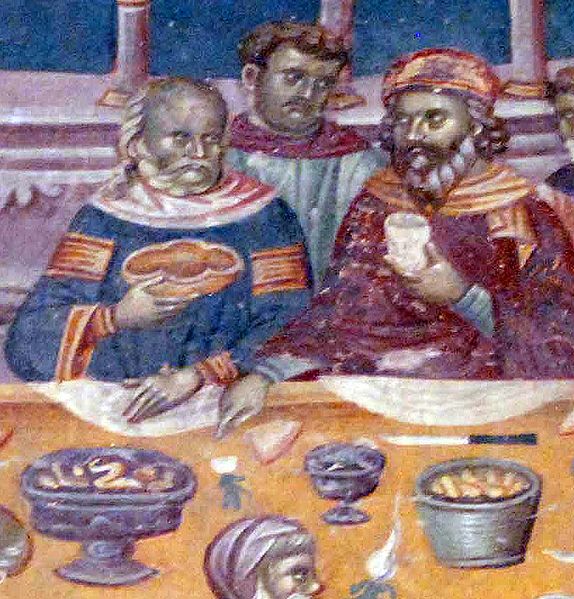
On the third day there was a wedding in Cana of Galilee, and the mother of Jesus was there.  Jesus and his disciples had also been invited to the wedding.  When the wine gave out, the mother of Jesus said to him, “They have no wine.”  And Jesus said to her, “Woman, what concern is that to you and to me?  My hour has not yet come.”  His mother said to the servants, “Do whatever he tells you.”  Now standing there were six stone water jars for the Jewish rites of purification, each holding twenty or thirty gallons.  Jesus said to them, “Fill the jars with water.”  And they filled them up to the brim.  He said to them, “Now draw some out, and take it to the chief steward.”  So they took it.  When the steward tasted the water that had become wine, and did not know where it came from (although the servants who had drawn the water knew), the steward called the bridegroom and said to him, “Everyone serves the good wine first, and then the inferior wine after the guests have become drunk.  But you have kept the good wine until now.”  Jesus did this, the first of his signs, in Cana of Galilee, and revealed his glory; and his disciples believed in him. John 2, 1-11; Gospel for Sunday, January 17.

For a specifically gay reflection on the Gospel, "Gospel for Gays" is exactly what it says:  a site with a particular focus on Gospel  reflections by Canadian Catholic blogger Jeremiah. For this week's Gospel on the wedding at Cana, Jeremiah asks us to imagine the scene as a "gay" wedding. 

Sunday Readings, 17th January: the Civil Partnership Celebration at Cana.


On the third day there was a wedding in Cana of Galilee, and the mother of Jesus was there.  Jesus and his disciples had also been invited to the wedding.  When the wine gave out, the mother of Jesus said to him, “They have no wine.”  And Jesus said to her, “Woman, what concern is that to you and to me?  My hour has not yet come.”  His mother said to the servants, “Do whatever he tells you.”  Now standing there were six stone water jars for the Jewish rites of purification, each holding twenty or thirty gallons.  Jesus said to them, “Fill the jars with water.”  And they filled them up to the brim.  He said to them, “Now draw some out, and take it to the chief steward.”  So they took it.  When the steward tasted the water that had become wine, and did not know where it came from (although the servants who had drawn the water knew), the steward called the bridegroom and said to him, “Everyone serves the good wine first, and then the inferior wine after the guests have become drunk.  But you have kept the good wine until now.”  Jesus did this, the first of his signs, in Cana of Galilee, and revealed his glory; and his disciples believed in him. John 2, 1-11; Gospel for Sunday, January 17.
For a specifically gay reflection on the Gospel, "Gospel for Gays" is exactly what it says:  a site with a particular focus on Gospel  reflections by Canadian Catholic blogger Jeremiah. For this week's Gospel on the wedding at Cana, Jeremiah asks us to imagine the scene as a "gay" wedding.