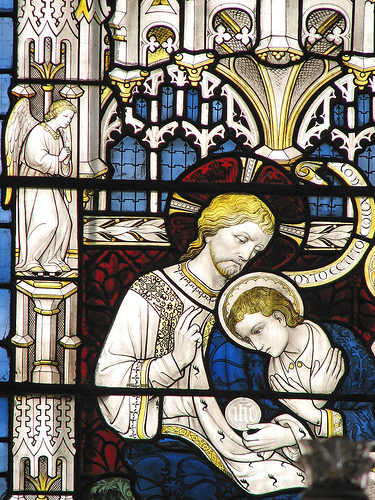
Showing posts with label Gay Jesus. Show all posts

Tuesday, 26 April 2011

Jesus: Not "Gay", but Genderqueer.


It appears from an article by Michael Ruse at the Guardian, that there is new evidence that Jesus was openly and unambiguously a gay man. Appearances are deceptive: this is a speculative piece, describing the texts he would like to see, when these newly discovered codicils have been translated. 

So what?

The interesting thing about this story is that while it is a piece of fiction, it actually makes very little difference to the core statements in the report: all (except for the unspecified parable, and the hypothetical quarrel with Joseph about manliness) are already known to us from the existing Gospels.

The Sexuality of Jesus

The absence of any direct reference in the Gospels to Jesus' love life,  sexual or emotional, has led to the unfortunate modern assumption that he did not have one, that he was in effect asexual. This is a bad mistake. We know that he was fully human, and do will also have had the full range of human bodily and emotional drives. We also know very little about his eating habits, hygiene practices or bowel movements - but this does not imply that he did not have any.  We may not know how Jesus responded to his sexual feelings, but we can be certain that he had them - just as we do.

The repeated references to a "beloved disciple" (whoever he is) are clear evidence of a special, even intimate,relationship. This evidence comes from the words used, but also from the privileged position given to him, physically and symbolically, at key points in the Gospel narrative (for example, at the last supper and at the crucifixion). It is widely assumed that the term applies to John the Evangelist, but this may not be so. Another candidate is Lazarus. Some scholars draw attention to a supposed Second Gospel of Mark, which supposedly tells that after raising a young man (Lazarus?) from the dead, Jesus spent the night in bed with him. There is also a peculiar story in Mark's Gospel of a night-time encounter in the garden with a young man covered only in a linen cloth, who then ran away naked.  We do not know who this mysterious young mas was, or what they were doing in the garden, but it too could have been Lazarus - and what do you think they were doing, in the dark and with one at least almost naked?

Personally, I reject the idea that Jesus was gay in any modern sense - the word is totally anachronistic, and there is in any case comparable evidence of a relationship with Mary Magdalene, which would make him at least "bi-" (in modern terminology. Intriguing as the evidence is that he may have had same-sex attractions or involvements, this evidence is at best supportive, but not conclusive proof.

Jesus and Mary Magdalene (Rubens)
 What can we say for certain?

Wednesday, 24 March 2010

Was Jesus Gay? Mark, and the "Naked Young Man".

Discussion of the question "Was Jesus gay?" usually revolves around the references in the Gospel of John, to "The disciple Jesus loved." These are well known, and have been widely discussed, here at QTC and elsewhere.  My reservations about these references are that they all come from the author of John's Gospel, talking about himself as writer. I would be more easily convinced by the argument if there were corroborating evidence from the other Gospels:  if Matthew, or Luke, or Mark, also made the same references to one specific disciple who was "loved" in a way the others were not, andsimlarly noted how he rested his head on Jesus' breast, or in his lap, and appeared to have inside information on Jesus thoughts and intentions - as John does.

Theodore Jennings, in "The Man Jesus Loved", might just have some such corroborating evidence, from the Gospel of Mark, and from infuriatingly fragmentary evidence from what just might be a lost,  more extended version of that Gospel: something known as the "Secret Gospel" of Mark. In the first part of the book, Jennings offer an extensive examination of the evidence from John's Gospel, and concludes that yes, the evidence is clear: there was indeed an unusually intimate relationship between Jesus and the author of that Gospel (whom he does not believe was in fact John). But then he continues, to look for further evidence from the other Gospels.
In Mark, he first draws our attention to a well-known passage which is seldom remarked on for homoerotic associations - the story of the "rich young man", drawing attention to the words of the text,:
Jesus, looking at him, loved him, and said....
Alone, this these words are not particularly remarkable, except that elsewhere in the Gospels, Jesus is not said to "love" specific individuals outside of the "beloved disciple" of John's Gospel. It becomes more interesting though, when read together with some other lines from Mark .  Jennings first discusses the curious matter of the "neaniskos", or "naked young man", in Jesus company in the Garden of Gethsemane:
And they all forsook him and fled.
And a youth ("neaniskos") accompanied him, clothed in a linen cloth ("sindona") over his nudity ("gumnos").  And they seized him.  And he, leaving his linen cloth, fled nude ("gymnos").
(Mark 14: 50 -52)
Who is this youth? What is he doing there? Why has he stayed behind, "accompanying" Jesus, after all the others have fled (at least until he is seized, and then flees, naked). Why is he so lightly clothed, that his garment can fall away so easily (the "sindoma" was not properly an item of clothing at all, but just a loose linen sheet)? And why use a word, "gymnos"  for nudity, which is strongly  associated with the homoeroticism of the Greek gymnasium - where young men exercised naked, and older men came to admire them?

But the most intriguing passage of all is found not in the standard Gospel of Mark, but in the so-called "Secret Mark", supposedly found by Morton Smith in an eighteenth century copy of a previously unknown letter of Clement of Alexandria, found in 1958.  The authenticity is disputed,  but some scholars accept that it authentic, and is taken from an earlier, longer version of Mark's Gospel than the one we use today.  I'm not going to get into the details of the origin or significance of this fragment  - see Jennings for that - but here is the bit that intrigues:
And they came into Bethany, and a certain woman, whose brother had died, was there.  and, coming, she prostrated herself before Jesus and says to him, "Son of David, have mercy upon me."..But the disciples rebuked her.  And Jesus, being angered, went off with her into the garden where the tomb was, and straightaway a great cry was heard from the tomb.  And going near Jesus rolled away a stone from the door of the tomb. And straightaway, going in where the youth was, he stretched forth his hand nad raised him, seizing his hand.  But the youth, looking upon him, loved him and began to beseech him that he might be with him.  And going out of the tomb they came into the house of the youth, and he was rich.  And and after six days Jesus told him what he wast to do and in the evening the youth comes to him, wearing a linen cloth over his naked body.  And he remained with him that night, for Jesus taught him the mystery of the kingdom of God. And then, arising, he returned to the other side of Jordan.
This passage has two literary connection to the two earlier passages from canonical Mark: the verb used here for he youth "looking at "Jesus is the same ("emblepein") as that  that used to describe Jesus when he "looked at" (and "loved") the rich young man;  and here again, he is described as wearing just a linen cloth over his naked body.  (This is not on being raised from the dead, when such a cloth would have been expected, abut when he came to Jesus six days later.

Now, be honest:  if a young man came to you, "in the evening", wearing "nothing but a linen cloth over his naked body", what do you suppose he was after?  And if he came not to you, but to another man, and then stayed the night, what do you suppose your conclusion would be in the morning?

The fragment known as Secret Mark may not be authentic - but then, it may.  If so, the implications and connections to the other two passages, and to John are at least intriguing.  Is this the same rich young man who turned down the invitation to sell all and follow the Lord?  is he the same young man in a linen cloth who stayed with him after all others had fled? Is he, indeed, the "beloved disciple?"

Friday, 19 March 2010

Was Jesus Gay?

According to Sir Elton John, the answer is clearly yes.


Sir Elton John is facing a backlash from conservative Christian groups after stating in an interview that Jesus was a gay man.

The 62-year-old musician also opened up to US magazine Parade about the "life-threatening downside" of fame and his relationship with partner David Furnish.

But it's the Rocket Man's views on Jesus's sexuality which have sparked headlines across the world.

In the interview, to be published in America on Saturday, Sir Elton said: "I think Jesus was a compassionate, super-intelligent gay man who understood human problems.
"On the cross, he forgave the people who crucified him. Jesus wanted us to be loving and forgiving. I don't know what makes people so cruel. Try being a gay woman in the Middle East - you're as good as dead."
I don't suppose Sir Elton has notable thological credentials for making this claim, but his fame alone will ensure that his remarks command wide attention. This is welcome, because the subjeect deserves more consideration than the easy assumptions that usually underlie thinking and speking about Jesus the man. Simply by raising the issue, Sir Elton has ensured that there will be amny voices raised in opposition and in support. Let us hope that some of these voices will offer some plain sense.

My own position here is simple.  I do not for a minute believe that Jesus was "gay", certainly not in any sense of the word that is recognisable in the moedern world.  But I do believe he was undoubtedly "queer", in that he emphatically did not conform to any usual expectations of sexual or gender conformity.

Let us begin with the obvious basics.  We know and accept as basic to theology, that Jesus was both fully human and fully divine.  The divinity does not concern us here, but the "human2 part surely does.  As fully human, and specifically male, we know that he had a fullly male physical body, and all that that entails. We must also accept that he had human emotions, human feelings - and those would certainly have included sexual feelings.

What he did about those, we do not know.  Did he act on them? Did he sublimate them? Some argue on scanty evidence for a sexual relationship with John the Evangelist, or with Mary Magdalene, or with Lazarus. All this is speculation.  We have no way of knowing for sure, although in thee absence of hard evidence, any of these are possible - as is complete celibacy.

So instead of complete celibacy, let us look at some basic facts, as we know them from Scripture and from history, starting with the latter.  The Pontifical Bible Commission recommends that the interpretation of Scripture includes some consideration of the historical context.  In first century Hebrew society, that would have included an overwhelming social expectation that all should marry and raise families, in a strictly hierarchical social structure. That society assumed an inferior position for women, who were not expected to join in regious discussion or leadership, assumed the place of slavery in human conduct, with extensive rights of slave owners over their "property", and followed a compleex set of purity regulations and taboos.

In his life and in his teaching, Jesus ignored all of these, and actively taught against some.  He never married (as far as we know), and exhorted his disciples to leave their own families to follow him. His closest friends outside the twelve were the houselhold of Mary, Martha and Lazarus - also all unmarried, living in a household that would surely have shocked many Jewish social conformists. On several occasions, he actively engaged with women in religious discussions.  And in his dealings with social outcasts of all kinds, including prostitutes, lepers, slaves or menstruating women, he ignored the purity taboos.  Doing so undoubtedly contributed to his getting up the noses of the religious leaders of the day, just as gay men, lesbians and transsexuals today continue to upset self-righteous and self-appointed religious leaders.
Jesus Christ - possibly not "gay" - but undoubtedly queer.

Sunday, 27 December 2009

St John the Evangelist, the "Beloved Disciple": December 27th

In the catalogue of "gay saints", or pairs of supposedly "gay lovers" in Scripture, the coupling of John the Evangelist (the "beloved disciple")  and Jesus himself is surely the most controversial. Many people, including some of my friends from the LGBT Soho Masses, find the whole idea that this may have been a "gay", sexually active relationship, highly offensive. Others argue the opposite case.

In an explosive book, "The Man Jesus  Loved",  the reputable biblical scholar Theodore Jennings mounts an extended argument that Jesus himself was actually gay and that the beloved disciple of John's Gospel was Jesus' lover.  To support this provocative conclusion, Jennings examines not only the texts that relate to the beloved disciple but also the story of the centurion's servant boy and the texts that show Jesus' rather negative attitude toward the traditional family: not mother and brothers, but those who do the will of God, are family to Jesus.  Jennings suggests that Jesus relatives and disciples knew he was gay, and that, despite the efforts of the early Church to downplay this "dangerous memory" about Jesus, a lot of clues remains in the Gospels.  Piecing the clues together, Jennings suggests not only that Jesus was very open to homosexuality, but that he himself was probably in an intimate, and probably sexual, relationship with the beloved disciple.
-Daniel Helminiak, Sex and the Sacred