Sunday, 14 February 2010

6th Sunday in Ordinary Time: 14th February

14th February: 6th Sunday of Ordinary Time

Jeremiah 17: 5-8

Psalm 1 1-4, 6 ; R 39:5

1 Corinthians 15: 12, 16-20

Luke 6: 17, 20-26
The first reading, from Jeremiah, reminds us to put our faith in the Lord, not in works of man, and on “things of the flesh,” which are arid, like dry scrub in the wilderness.  Instead,  we are advise to put our trust in the Lord, for then we “will have no worries in a year of drought, and will never cease to bear fruit.”
These are wise words indeed, but we could also do well to remember that works of the flesh are not the only works of man.  Sadly, the same can be said of the institutional church, which in its teaching on sexuality is also arid and devoid of life giving sustenance. However, if we pay attention instead to the words and example of Christ himself, and develop through our prayer life a personal relationship with Him, we too can find a source of life-giving nourishment, and “shall never cease to bear fruit”.

Sunday, 24 January 2010

Fishing for Souls: 5th Sunday in Ordinary Time, 7th February.

Isaiah 6:1-8

Psalm 137: 1-5, 7-8

1 Corinthians 15: 1-11

Luke 15: 1-11
What does “apostle” mean to you?  For many people, there is an assumption that it ahs something to do with being of the elect, one of “the twelve”, or the inner circle.  But the word itself has nothing to do with this- and Scripture itself is not at all clear that there were just twelve apostles:  where the word is used, it refers in different contexts to different groups.  At times it is indeed used to refer to the twelve- at other times it is used interchangeably with “disciples”, to refer to a wider body of followers (and at least one woman, Junia, is described as an apostle).
The word itself simply means one who is sent – derived from “apostello” – I  send.  Today’s readings from Isaiah and from Luke remind us that in this sense we are all apostles. Isaiah tells how, seeing himself as unworthy, as a wretch, he nevertheless heard the Lord asking “Whom shall I send?”, to which he answered (to his own surprise, I suspect), “Here I am, end me.” Simon, on the lake shore after the miracle of the fishing boats, is overwhelmed by his own unworthiness, and pleads with the Lord to be left alone in his sinfulness. But the Lord will have none of it, and assures him that henceforth, he will be a fisher of men.


[caption id="attachment_4764" align="aligncenter" width="560" caption=""Fishers for Souls", Adriaen Pietersz. van de Venne (c. 1589, Delft – 1662, The Hague)"][/caption]
Now, being chosen does not mean that Isaiah and Simon were mistaken in their earlier self-assessments.  They believed they were wretched sinners – and so they were, just as we all are.

Sunday, 17 January 2010

Sunday Readings, 17th January: the Civil Partnership Celebration at Cana.

p style="text-align: center;">

On the third day there was a wedding in Cana of Galilee, and the mother of Jesus was there.  Jesus and his disciples had also been invited to the wedding.  When the wine gave out, the mother of Jesus said to him, “They have no wine.”  And Jesus said to her, “Woman, what concern is that to you and to me?  My hour has not yet come.”  His mother said to the servants, “Do whatever he tells you.”  Now standing there were six stone water jars for the Jewish rites of purification, each holding twenty or thirty gallons.  Jesus said to them, “Fill the jars with water.”  And they filled them up to the brim.  He said to them, “Now draw some out, and take it to the chief steward.”  So they took it.  When the steward tasted the water that had become wine, and did not know where it came from (although the servants who had drawn the water knew), the steward called the bridegroom and said to him, “Everyone serves the good wine first, and then the inferior wine after the guests have become drunk.  But you have kept the good wine until now.”  Jesus did this, the first of his signs, in Cana of Galilee, and revealed his glory; and his disciples believed in him. John 2, 1-11; Gospel for Sunday, January 17.

For a specifically gay reflection on the Gospel, "Gospel for Gays" is exactly what it says:  a site with a particular focus on Gospel  reflections by Canadian Catholic blogger Jeremiah. For this week's Gospel on the wedding at Cana, Jeremiah asks us to imagine the scene as a "gay" wedding. 

Sunday Readings, 17th January: the Civil Partnership Celebration at Cana.


On the third day there was a wedding in Cana of Galilee, and the mother of Jesus was there.  Jesus and his disciples had also been invited to the wedding.  When the wine gave out, the mother of Jesus said to him, “They have no wine.”  And Jesus said to her, “Woman, what concern is that to you and to me?  My hour has not yet come.”  His mother said to the servants, “Do whatever he tells you.”  Now standing there were six stone water jars for the Jewish rites of purification, each holding twenty or thirty gallons.  Jesus said to them, “Fill the jars with water.”  And they filled them up to the brim.  He said to them, “Now draw some out, and take it to the chief steward.”  So they took it.  When the steward tasted the water that had become wine, and did not know where it came from (although the servants who had drawn the water knew), the steward called the bridegroom and said to him, “Everyone serves the good wine first, and then the inferior wine after the guests have become drunk.  But you have kept the good wine until now.”  Jesus did this, the first of his signs, in Cana of Galilee, and revealed his glory; and his disciples believed in him. John 2, 1-11; Gospel for Sunday, January 17.
For a specifically gay reflection on the Gospel, "Gospel for Gays" is exactly what it says:  a site with a particular focus on Gospel  reflections by Canadian Catholic blogger Jeremiah. For this week's Gospel on the wedding at Cana, Jeremiah asks us to imagine the scene as a "gay" wedding. 

Sunday, 27 December 2009

St John the Evangelist, the "Beloved Disciple": December 27th

In the catalogue of "gay saints", or pairs of supposedly "gay lovers" in Scripture, the coupling of John the Evangelist (the "beloved disciple")  and Jesus himself is surely the most controversial. Many people, including some of my friends from the LGBT Soho Masses, find the whole idea that this may have been a "gay", sexually active relationship, highly offensive. Others argue the opposite case.

In an explosive book, "The Man Jesus  Loved",  the reputable biblical scholar Theodore Jennings mounts an extended argument that Jesus himself was actually gay and that the beloved disciple of John's Gospel was Jesus' lover.  To support this provocative conclusion, Jennings examines not only the texts that relate to the beloved disciple but also the story of the centurion's servant boy and the texts that show Jesus' rather negative attitude toward the traditional family: not mother and brothers, but those who do the will of God, are family to Jesus.  Jennings suggests that Jesus relatives and disciples knew he was gay, and that, despite the efforts of the early Church to downplay this "dangerous memory" about Jesus, a lot of clues remains in the Gospels.  Piecing the clues together, Jennings suggests not only that Jesus was very open to homosexuality, but that he himself was probably in an intimate, and probably sexual, relationship with the beloved disciple.
-Daniel Helminiak, Sex and the Sacred

Sunday, 20 December 2009

Ruth & Naomi

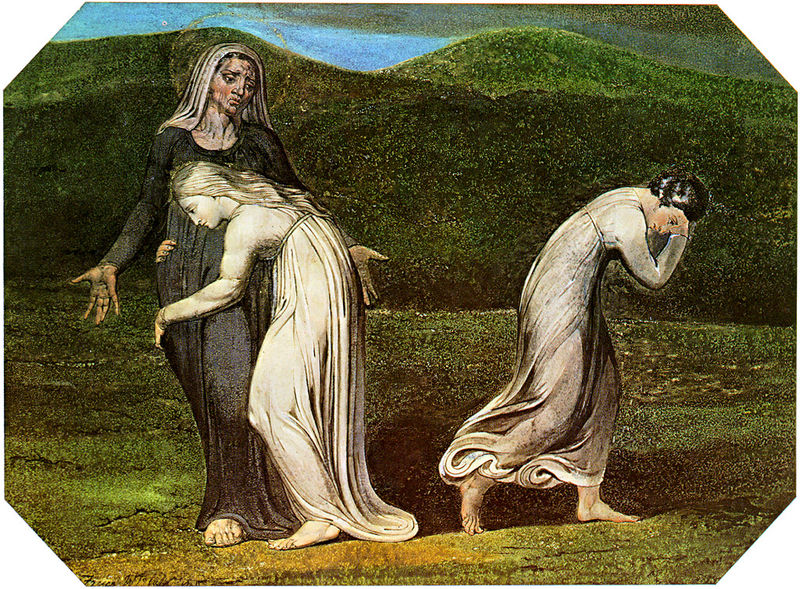
The story of Ruth and Naomi is widely quoted by queer writers as an example from Scripture of possible lesbian love:  but how relevant is it?  Superficially at least, it is just a simple story of exceptionally strong family affection and loyalty, between mother- and daughter- in-law. Whether in any way “lesbian” or not, the story is relevant, but not perhaps in the way usually told.  To unravel  the lessons it may hold for us, let’s begin with the simple story.

Naomi was an Israelite widow, living for a while (on account of famine) in Moab, where she married her two sons to Moabite women, Orpah and Ruth. The sons later died, leaving Naomi “all alone, without husband or sons” ,

She did have two daughters-in-law, and when she heard that conditions back in Israel had improved, she returned, initially taking her two daughters-in-law with her. She then had a change of heart, and encourages the two women to return to their own home in Moab. After some persuasion, Orpah did so, but Ruth refused.

Do not press me to leave you
Or turn back from following you!
Where you go I will go,
Where you lodge, I will lodge;
Your people will be my people, and your God my God.
Where you die, I will die –
There  will I be buried.
May the Lord do thus and so to me,
and more as well,
if even death parts me from you
.
(Ruth 1: 16-17)

Wednesday, 4 November 2009

Noah's Queer Ark


Well, isn't the rainbow part of the story, as well as a major gay symbol? What other couples would you expect? Kittredge Cherry at Jesus in Love blog has some wonderful shots of a painting by Paul Richmond, depicting well -known gay coples, and same sex animal pairs, enjoying married bliss on the decks, with prominent foes of equality drowning in the sea.  Kittredge writes:

600px-Rainbow_in_Budapest


He was moved to create the work after California’s Proposition 8 banned same-sex marriage last fall. Demonstrations across the United Stin support of marriage equality inspired Richmond to paint a wickedly funny satire on the classic Bible story.


In Genesis 6-9, God commands Noah to gather his family and heterosexual pairs of animals into a boat to rescue them from the global flood sent to destroy human evil and the violence of nature. After the flood, a rainbow appears as a symbol of God’s promise never again to destroy all life on earth.
How appropriate that the rainbow has become a symbol of GLBT pride! Richmond puts a fresh twist on the Biblical epic with his sweeping vision of a gay-positive new world. A rainbow flag flies high on the mast of Noah’s gay cruise ship. “As the clouds begin to part, a heavenly rainbow appears in the sky to remind hopeful voyagers that full legal recognition and acknowledgement of same-sex love is just over the horizon,” Richmond explains.
This is huge fun, with the visual puns spelt out for those unable to instantly recognise each face.  Just what we need to cheer us in the aftermath of the loss in Maine:  a reminder that victory in the long run will still be ours. Treat yourself.  Go to Jesus in Love and have a look.


Apart from fun, of course, the idea of gay couples on the ark is entirely appropriate. Sexual diversity is everywhere in the animal kingdom, just as it is in human society. See "Natural Families: The Wildlife Rainbow", at Queering the Church.